Neo-AI, the new age of AI, is powered by different architectural patterns. These include Gen-AI, LLM, and SLM powered operations. It also encompasses custom developed Agentic-AI decisioning nodes, orchestration, and workflows. Alternatively, you can leverage Agentic-capabilities with out of the box product suites. Examples are SAP Joule, Salesforce Einstein, ServiceNow Assist, MS, and *Copilots. These advancements are designed to cut the Total Cost of Enterprise Operations (IT and BPO). The aim is to reduce costs by up to 60% in 5 years. This reduction is realized from 70% of workforce reduction. Are CEOs, CFOs, CIOs, COOs are looking for only labor cost reduction or total enterprise operations cost reduction? Question is then if the $$ saved in Labor gets reallocated to other technology charge buckets, what is the real business cases of aggressive AI-led operations? Question further is, would we need to recall the labor because much of design, architecture blueprint, code refactoring, test case identification, testing strategy, operational healings went wrong due to overreliance on AI?
While we arrive at the business case, are we discounting the cost of operations increase due to 10-12 % CAGR of business growth OR we are assuming AI-led operations will seamlessly absorb any volume growth? We all know how futile Change Requests and Baseline adjustment discussions would be if we say business case is pegged to current state SLAs, KPIs, and Volumes. End of the day we are talking of operations being a Fixed Cost resilient to externalities and hence the cost reduction only inches towards a plausible 100%. Considering the Enterprise Weighted Average Cost of Capital, the AI-led transformation programs are going to seem NPV positive, yielding positive cash flows from at most year 2 onwards leaving a high terminal value in the long-term. Then Question is what will happen to the next technology revolution in 2034 (every 10 year we usually see a disruptive technology charter).
Let us assume “Enterprise” Operations Spend $ 100 split into primarily the below charge buckets we will see the net reduction is around 8-10% vs 60-70% expected.
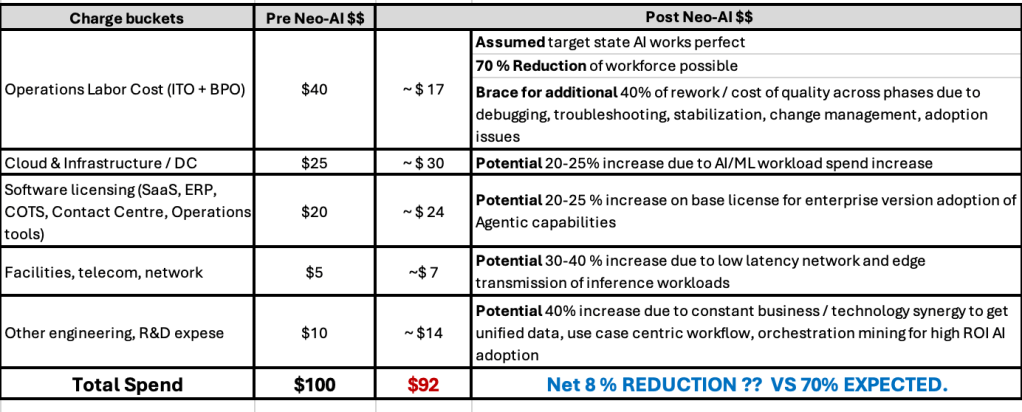
This symptom of shifting $$ exists even if we inspect inside the categories above. For example, let us peek inside the Cloud & Infrastructure spend $ 25
- Consider end user computing cost – # of total end points may be assumed to reduce by a linear % of workforce reduction, but that will be offset by users play ing multiple personas, needing more than one device, accessing more end points etc.
- Likewise, while the ITSM incident management, ticketing, healing and infrastructure operations would be AI-led, FTE cost would reduce but the non-FTE cost for tools, unified data lake, compliance, governance, monitoring, quality control, audit, compliance and reporting would offset some of the reduction.
- Moving on, the # sum totality of server endpoints (hosting all enterprise workloads, end user workloads, AI / ML training workloads, AI / ML inference workloads), either on-prem, private cloud, public cloud, edge – for operations will be offset from compute and server modernization initiatives.
- The need high availability and resiliency for accessing above workloads will demand high redundancy in network links, availability zones, and mandate more active-active backup and recovery architectures needing more investment overall.
- Storing and processing massive amounts of data becomes pivotal since without precise data pipeline, unified data view and processing across the enterprise (IT data, ERP data, SaaS data, Audit, Compliance, Info-sec data) neo-AI will only lead to more work and spend. So, data base optimization cost reduction will be offset.
- Consider the rise in ESG spend – though not everything is part of the enterprise – the $$ shifts to some entity managing the environment and sustainability in the ecosystem
So, conclusion is net spend may certainly reduce but not to the extent anticipated in today’s discussion. I also anticipate workforce reduction happening now to be followed by workforce recall in the next couple of years.
Onus is on technology leaders like us to responsibly manage the shift of cost bucket – work with business and operations leader to mine right high value high ROI use case – work with technology partners and architects to create the optimal AI-led solution – work with SDLC and engineering teams to put the right design and algorithms in place – work with operations teams to ensure right data and metrics is collected to measure the success or course-correct fast – judiciously to ensure we do not hastily throw neo-AI led operations everywhere, cut down workforce randomly, and promise business and IT outcomes unless we have controlled all externalities.
 Welcome to your Blog CHATS01, where we exchange CHATS passionately on how to address CEO and Business needs through a compelling TECHNOLOGY STRATEGY-101 to ensure business resiliency and profitability !!
Leave a comment