
At a recent CIO round-table, I got a chance to discuss infrastructure operations and automation. We debated the adoption of automation and AI. Traditional AI / ML has been dominating the tale of business efficiencies thus far. With the recent influx of Gen-AI, Copilots, and now Agentic AI, there was a clear strategy question. How do we blend the options to maximize economic value? More so, what finally stays back for humans in the loop? Technology’s evolution and its adoption for use-cases have never seemed so complex. Welcome to the race to showcase maximized economic value and heightened business efficiencies for the CIO !!
While Traditional AI / ML has been instrumental in deriving intelligence from massive datasets, curated to context. From there on, the patterns are applied using techniques like linear regression, logistic regression, deep learning, and SVM. They also include generating aggregation, classification, and decision nodes. These patterns are then integrated into human-facing, device-facing, or BOT (automation scripts) assisted operations. This results in quicker turn-around time, accuracy, precision, and risk prevention. Altogether, this is collectively known as business efficiencies. Bear in mind, here the BOT either executes or aborts. It can’t self-drive, decide, navigate, or orchestrate breaking the loop. Traditional AI / ML outcomes or nodes swiftly gets escalated to a human channel.
Now, Gen-AI served as an expansion and extension to use case. It helped create massive intelligent contextual understanding. It enabled artifact creation and removed some elements of human in the loop. This beefed up business efficiencies. This was achieved using deep, resource intensive computation and generating human-like artifacts/responses.
And now with Agentic AI the entire ecosystem behaves like a human in loop or multiple cross-functional humans in loop.
(a) AI/ML driven intelligence is derived from the datasets. (b) One or several BOTs are triggered. (c) Concepts of fork and join are applied to spawn multiple BOTs, combine the outcomes, decide and move on. (d) It triggers workflows for more refined process paths. (e) It triggers a round of Gen AI for content creation or prompts to BOT or agents. (f) It triggers workflows of notification, communication, voice calls, phone calls with massive orchestration. (g) It takes on human niche tasks like auto-approval. It adjusts limits and thresholds based on Straight through processing rules set and then moves on. (h) It auto-completes server starts, payment processing, deal reconciliation, document dispatch, leads campaign and more. This process happens in recursion until an human-defined “must-exit” node is hit. So we clearly see the need to defer to a human channel. It has been deferred to the right a lot now.
Imagine this happening in parallel across teams and departments in industries. It drives instant collaboration with multiple virtual agents. They carry out work in parallel, think through decision nodes and outcomes, and choose the best recourse. It simulates a day in the life of multiple human operations teams on the floor! If all this has been defined, configured, programmed, and tested efficiently, how will the operations floor be in 3 years? What changes and advancements should we expect? How will the operations floor evolve over this time?
Now shall we compare to co-pilots for a moment and clear our confusion on adopting Co-pilot vs Agentic? Copilots are across Microsoft Copilot, GitHub copilot, Salesforce’s Einstein Copilot, and SAP Copilot Joule. These copilots are getting integrated very purposefully into automated operations. These operations include NOW Assist, custom Virtual Assistants, DevOps pipelines, SecOps pipelines, and other custom BOTs/scripts. So, is that then creating the agentic experience? Well and illusion of it!!
Copilot or any AI integrating with automation led operations are clearly not catering to(a) non-provider ecosystem which are part of the enterprise tech stack, (b) difficult for external integration with authorization and authentication sync, (c) does not support flexibility of multiple LLMs, (d) does not support multiple integration tool and technology led integration, (e) does not take real time complete actions, (f) difficult to traverse knowledge graphs created for enterprise data, (g) does not support multi-step agents, (h) does not support enterprise search from enterprise data sets, (i) may not support structure and unstructured data, (j) does not have flexibility to add in your plugins, and templates for your custom business process
In my life of running tech and operations let me take a use-case so that you can evaluate your current state and decide the strategy of adoption:
A common Infrastructure operations Use case: Latency reported by global application users. And solution could be restarts, killing hung / unused VMs/CPUs, spinning-up up more servers (compute, database etc.), diversion to secondary servers, diversion to CDN nodes, a static content server, clearing network clog, and so on. Once the incident is addressed, there is extensive reporting, clean-up, and closure needed. Audit and RCA must also be done. Problem management, and change management as needed. Enhancements, patches, and OEM coordination and everything needed to fix the root issue and prevent recurrence. So think about the deluge of effort that an incident can cause.
Now let’s look at how to choose AI vs Gen-AI vs Agentic-AI or mixing them. Selection Strategy assumes that below enablers are available:
- Observability tools for Cloud, On-prem, application, or Security monitoring in a unified view
- AIOPS tool to capture logs, feed, metrics, alerts from monitors and does noise cancellation, correlation, anomaly detection
- Leverages inbuilt MLOPS to do all above and finally log unique incident
- ITMS tool integrated with AIOPS capturing the final unique incident with auto-ticketing, orchestration, workflow automation and infra heal scrips
- Contact Centre solution integration with ITMS tool or a bridge orchestration layer
- User channel integration (phone, email, IVR, chat etc) integration with ITMS or a bridge orchestration layer
- Analytics and Dashboard integration for decision makers and approvers
- Email integration for notification to stakeholders
- Document integration for mixing static and dynamic contents for incident RCA, document generation and storage for future reference and audits
- SOP integration for updating the SOPs with insights of current incident
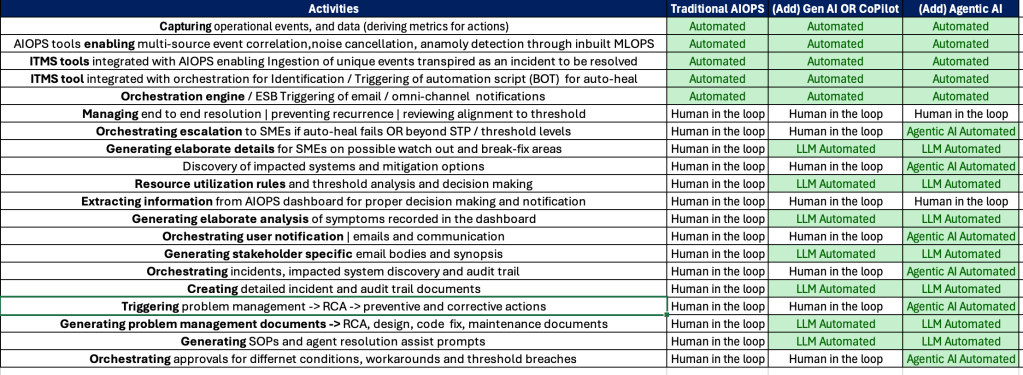
So, what is left for humans? In conclusion, a lot still remains to be done. (a) We need to define the use case for adoption, architect, design and build for value adoption. (b) We must prove that the tools are robust to capture more diversified events. They should also capture a combination of these events. (b) We must define and revise RAS (reliability, availability, and scalability) metrics. It’s important to show their quantifiable attributes for each infra resource, like compute, storage, network, and database. This includes business continuity, perimeter security, data security, endpoint security, and more. (c) We translate these into a mesh of rules engines. This helps manage the correlation and traceability of layers, enabling Agentic AI to make foolproof decisions (simulating the human brain). (d) Enabling tech-enabled operations involves setting approval limits, conditions, and criteria for credible Agentic AI-based approvals. (e) We create multi-platform executable and portable scripts. These are essential for seamless integration into the hyper-automation framework of AIOPS, Gen-AI, and the Agentic AI ecosystem. (f) Continuously refining the automation architecture is crucial. It helps us adapt to the ever-changing technological revolution. And by the way designing, defining, deploying and curating the base solution – AI, Gen-AI, CoPilot, Agentic AI ?
Stay tuned!! Add your perspectives and help us build responsible technology outcomes with heightened economic value!!
 Welcome to your Blog CHATS01, where we exchange CHATS passionately on how to address CEO and Business needs through a compelling TECHNOLOGY STRATEGY-101 to ensure business resiliency and profitability !!
Leave a comment